


Engineering Profession Act, 2000 (Act No. 46 of 2000)Board NoticesGuideline Scope of Services and Professional FeesScope of Services and Tariff of Fees for Persons Registered in terms of the Act1. Preamble and Definitions1.1 Preamble |
This Guideline Scope of Services and Professional Fees is published by the Engineering Council of SA (ECSA) in terms of Section 34 of the Engineering Professions Act of 2000, which requires ECSA to annually review and publish guideline professional fees.
The guidelines for determining fees for consulting engineering services are in accordance with the Council for the Built Environment (CBE) Policy Framework on Professional Fees following principles which are intended to promote competition in the market place based on both quality and price.
The Guideline is for guidance purposes only and follows the arm’s length principles of fair market value, being competitive not prescriptive, and therefore does not amount to direct or indirect price fixing.
The Guideline comprises three main sections:
| • | Clause 1 and Clause 2: General information, including the Preamble, Definitions and General Provisions |
| • | Clause 3: Guideline Scope of Services which describes the typical services performed by a consulting engineer as part of a professional services contract, and includes specialist engineering services and studies, normal services which the consulting engineer is expected to perform, and additional services which are services not normally part of the responsibility of the consulting engineer and which require special agreement between the client and consulting engineer. |
| • | Clause 4: Guideline Fees which provides general guidance on how to calculate the fees for consulting engineering services. The guideline fees describe four aspects of remuneration, namely: |
| o | Percentage fees based on the cost of works for normal services, which is a simple and popular method for calculating fees and is a convenient method if the scope of the work is reasonably well defined. |
| o | Additional fees for services that are additional to those provided for in the normal percentage fee-based calculation |
| o | Time-based fees which is a useful method for determining the fee where the scope of the work and services is uncertain at the time when the consulting engineer is appointed. |
| o | Expenses and costs which are remuneration for reimbursable expenses. |
The professional fees applicable for a project may be determined either by a process of direct negotiation between the client and consulting engineer or following a process of procuring competitive bids from different consulting engineers. Whatever process is used, the guideline scope of services described in Clause 3 and the guideline fees described in Clause 4 of this Guideline form a useful baseline for the determination of the scope of services and the fees.
The client may expect the consulting engineering fees for a project to vary widely according to a number of factors, the most significant being the project size (monetary value), type (building or engineering project), and engineering discipline (civil, structural, electrical, mechanical, etc) and it is for this reason that a number of different fee tables, together with different complexity factors, are presented in Clause 4. The typical broad range of percentage fees applicable to different size projects and services provided is shown in the graph below.
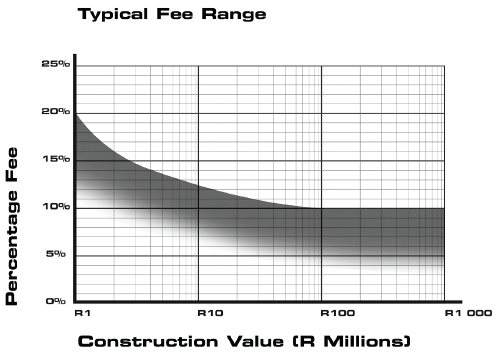
The graph is provided as a pictorial representation which illustrates how the fee may vary over a broad range depending on construction value and must not be used to try to determine an actual fee percentage. The fee should generally fall within the broad band as indicated on the graph, but it may also fall outside the band depending on the competitive procurement process followed as well as the project size, type, engineering discipline and the many other factors which may influence the magnitude of the fee. There is no upper (maximum) or lower (minimum) limit to the fee. As stated above, the fees determined in accordance with this Guideline are not prescriptive and are provided for guidance only.
The process of appointing a consulting engineer should commence with the drafting and signing of a formal agreement which stipulates items such as the agreed services, professional fees as agreed to, commercial terms such as duration of agreement, responsibility of parties, limit of professional liability, payment terms, breach, termination and dispute resolution, etc.
The commercial terms of the appointment should be based on a standard form of professional services contract of which several different options are available, or a bespoke agreement to be drawn up between the client and the consulting engineer. The agreement will also include the specific contract data applicable to the project under consideration as well the scope of the project work and the scope of services required of the consulting engineer.
This guideline is not prescriptive but has been produced as an aid to assist a client and the consulting engineer in reaching an equitable agreement on fees for services offered based on both the quality of the service provided as well as the price.
In the event that the client and the consulting engineer are unable to reach agreement on the fees, either party may conclude the negotiations and provided that there is no contractual relationship between the parties, the client is then free to initiate negotiations on fees with another consulting engineer. Once a professional services agreement has been concluded between the client and the consulting engineer, then the right of recourse which either party may have against the other will be in accordance with the provisions of the agreed contract.