Marketing of Agricultural Products Act, 1996 (Act No. 47 of 1996)Notices2026 NoticesEstablishment of Statutory Levies on Milk and other Dairy Products and the determination of Guideline Prices in respect of Milk and other Dairy ProductsSchedule |
| 1. | Definitions |
In this schedule any word or expression to which a meaning has been assigned in the Act shall have that meaning, unless the context otherwise indicates—
means the end users of milk;
means a person that produces milk by the milking of cows, goats or sheep;
means persons that sell milk directly to consumers; and
means the Marketing of Agricultural Products Act, 1996 (Act No. 47 of 1996), as amended
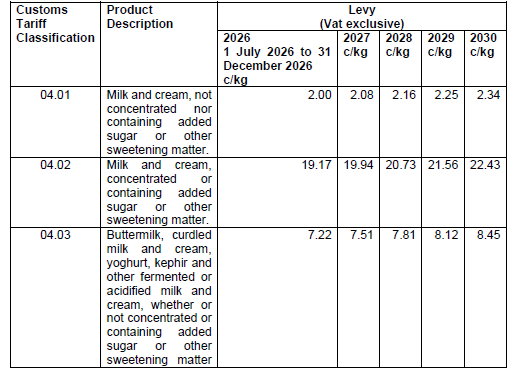
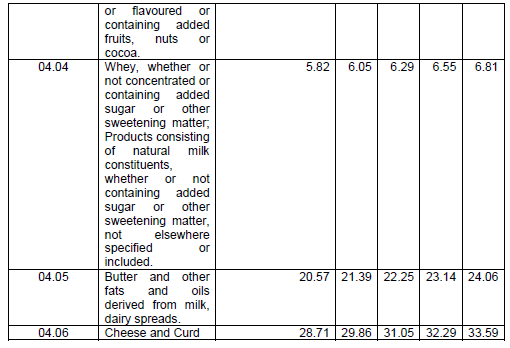
| 2. | The products subject to the levies and the levies are as follows: |
| 3. | The levies set out under 2 shall be paid by: |
| (a) | Persons who buy raw (unprocessed) milk for the purpose of processing it or to use it to manufacture other products, or to sell it to persons located outside the jurisdiction of the Republic of South Africa, or to move it outside the jurisdiction of the Republic of South Africa; |
| (b) | Persons who import a product which is subject to a levy in terms of 2; |
| (c) | Persons who are milk producers and who process the raw (unprocessed) milk produced by them, or use it to manufacture other products, or who sell it to consumers, or who sell it to persons located outside the jurisdiction of the Republic of South Africa, or who move it outside the jurisdiction of the Republic of South Africa; and |
| (d) | Persons who sell raw (unprocessed) milk to retailers. |
| 4. | The levies set out under 2, shall be paid by the persons listed in 3 to Milk SA not later than 15 days after the month in which the actions that created the levy liability, took place. |
| 5. | The payment of levies shall be accompanied by the levy return form as prescribed by Milk SA. Payment and levy return forms shall— |
| (a) | when forwarded by post, be addressed to: |
Milk SA
PO Box 1961
Brooklyn Square
0075
| (b) | when delivered by hand, delivered to: |
Milk South Africa NPC
Brooklyn Court Building B
First Floor
361 Veale Street
Nieuw Muckleneuk
Brooklyn
Pretoria
0181
| (c) | when submitted electronically, be addressed to: |
Milk SA
ABSA Bank
Acc. No. 405 895 6897
Branch: Brooklyn
Code: 634 156
The return form can electronically be conveyed to Milk SA at:
| 6. | The statutory measure described in this schedule shall— |
| (a) | apply within the geographic area of the Republic of South Africa. |
| 7. | This levy shall come into operation on 1 July 2026 and will lapse after a period of four and a half years. The lapsing of this statutory measure shall not— |
| (a) | affect the previous operation of the statutory measure so lapsed or anything duly done or suffered under the statutory measure so lapsed; or |
| (b) | affect any right, privilege, obligation or liability acquired, accrued or incurred under the statutory measure so lapsed; or |
| (c) | affect any penalty, forfeiture or punishment incurred in respect of any offence committed against the statutory measure so lapsed; or |
| (d) | affect any investigation, legal proceeding or remedy in respect of any such right, privilege, obligation, liability, forfeiture or punishment as acquired, accrued or incurred in terms of the statutory measure so lapsed, |
and any such investigation, legal proceeding or remedy may be instituted, continued or enforced, and any such penalty, forfeiture or punishment may be imposed, as if the statutory measure had not lapsed.
| 8. | The purpose of the levies set out under 2, is to finance actions that are necessary to further, in respect of the dairy industry, the objectives set out in section 2(2) of the Act, and it is as follows: |
| (a) | Consumer Education (Service provider: SAMPRO) |
From a national point of view and to promote the viability of the dairy industry, consumers should be informed of the health and nutritional advantages of milk and other dairy products. Informed consumers will not only contribute to the national well-being in respect of nutrition and health, but especially also to the viability and sound development of the dairy industry. The education will be conducted in such a way that it will not erode the marketing activities of any firm in the dairy industry that are aimed at differentiating its products from those of competitors.
| (b) | Improvement of the quality of milk and other dairy products (Service provider: DSA) |
From a nutritional and health point of view, milk and other dairy products have important roles to play in the national household. In order to protect the integrity of milk and other dairy products, consumer interest and fair competition, the promotion of compliance of these products with the compositional, food safety and metrology standards are required. Also, work must be conducted to deal with amendments of these standards, the creation of new standards in light of, for example, technological developments and the work of Codex, as well as voluntary standards to which references are made in the legal standards. The abovementioned actions are important issues in respect of the viability of the dairy industry and the growth of the markets for the products concerned.
| (c) | Empowerment of previously disadvantaged individuals (Service provider: MPO) |
The activities consist of support to Black enterprise development in the dairy industry. These are in line with the National Agricultural Marketing Council (NAMC) Transformation Guidelines. The Black dairy enterprise development activities are managed by the Milk SA Project Manager: Transformation, and in respect of it, the following:
| • | It consists of support for black enterprises in the dairy industry based on an analysis of the factors that limit the development of the enterprises concerned; |
| • | The support is in terms of a holistic approach, which recognises that success in the dairy industry is also dependent on factors outside the control of the individual enterprises. As a result, Milk SA also facilitates support for the enterprises concerned from bodies in the public and private sectors, such as input suppliers and other parties in the value chain; and |
| • | The support that Milk SA provides to black enterprises addresses some of the constraints that limit their development and seeks to accelerate the sustainable growth and participation of black enterprises within the dairy industry. |
| (d) | Dairy Animal Health and Welfare (Service provider: MPO) |
Dairy animal health and dairy animal welfare are interrelated, and part of the broader biosecurity of the dairy value chain, and of great importance in respect of the performance of the dairy industry as well as for consumers, as, amongst others, particular diseases can impact on food safety of milk and other dairy products. The project will function as an enabler for positive dairy food security and is part of the building blocks of a viable, prosperous dairy industry.
The objective is to deal with issues of dairy animal health and welfare, which are of collective importance, and which cannot be sufficiently dealt with by individual enterprises in the dairy industry.
The work in respect of dairy animal health and welfare includes:
| - | Promoting of compliance with the various acts, regulations and voluntary standards relevant to dairy animal health and welfare; |
| - | Contributing to the development of acts, regulations and voluntary standards, as required by changing circumstances; |
| - | Disseminating expert dairy animal health and welfare information to members of the dairy industry and other role-players; |
| - | Interacting and collaborating with national and provincial government departments and other institutions in the public sector; and |
| - | Interacting and collaborating with organisations of other animal industries, organisations of animal health and welfare experts and international organisations. |
| (e) | Research and Development (Service provider: MPO) |
The objective is to promote research and development that is functional in respect of the strategic direction of the South African dairy industry, namely, to improve the competitiveness of the dairy industry, broadening the market for dairy products and empowerment of previously disadvantaged individuals.
Environmental issues are of increasing importance and require research and interaction with international bodies and different government departments, as well as interaction between members of the South African dairy industry, in order to deal with environmental issues of collective importance.
The fields of knowledge relevant to the dairy industry are especially the fields in respect of soil, plants, dairy animals, milk and other dairy products, environmental issues and production, processing and manufacturing technologies.
Milk SA takes actions that promote coordination between research institutions, research that is functional in respect of the strategic direction of the South African dairy industry and the practical application of local and international research results and development by the South African dairy industry. These actions are taken in consultation with government research institutions and other research institutions.
| (f) | Industry Information (Co-service providers: SAMPRO and MPO) |
Statistical information and other information regarding the dairy industry in South Africa and internationally, and analysis of such information are required to promote market access in respect of the dairy industry, the efficiency of marketing of milk and other dairy products, and the viability of the dairy industry. The information regarding the dairy industry and the analysis thereof makes market signals visible for role players in the industry, which is a prerequisite for the effective functioning of markets and the prevention of the wasteful use of national resources. Also, it provides information required by Government institutions and contributes significantly to the achievement of the relevant objectives of the Act. This also includes work about Custom duties and Market Access, which contributes to a trade dispensation that supports the growth and development of the dairy industry in South Africa and interaction with the International Dairy Federation.
| (g) | Dairy technical skills and knowledge development (Co-service providers: MPO and SAMPRO) |
The dairy industry demands employees with specialised dairy technical skills and knowledge, and the provision of such skills and knowledge is of crucial importance to facilitate transformation in the industry and the competitiveness of the industry, which is a prerequisite for the growth of the industry and transformation in the dairy industry;
Some of the actions to promote skills and knowledge can only be dealt with by projects of Milk SA, financed by Milk SA from income from the levies. The reason for this is that such actions are of true collective interest, the actions cannot be financed in any other way, and it is required to enable people to obtain officially recognised part or full qualifications. The specific actions are:
| ▪ | Continuous evaluation to determine whether, due to factors like technology development, changing production and manufacturing procedures and requirements set by relevant bodies in the public sector, amendment is necessary of, for example, the curriculum, learning materials, assessment tools and qualifications; |
| ▪ | Interactions in respect of acts, regulations, policies and procedures regarding knowledge and skills development in light of the needs of the dairy industry, with the authoritative bodies in the public sector and representatives of other industries; and |
| ▪ | Guidance in respect of skills and knowledge development to members of the dairy industry and promotion of it. |
The requested levies can in no way negatively impact on any of the matters set out in section 2 (2) and section 2 (3) of the Act.
Collectively, the requested measure will create a more viable dairy industry that will enhance the matters set out in section 2(3) of the Act, namely food security, the number of employment opportunities, and fair labour practices.
| 9. | The expenditure of the income from the levies during the period in respect of which the levies exist shall be determined in such a way that: |
| (a) | not more than 10 per cent of the income from the levies be spent on the administration of the measure described in this schedule, and |
| (b) | at least 20 per cent of the income from the levies is spent on the empowerment of previously disadvantaged individuals. This will be in line with the NAMC transformation guidelines. |
| 10. | The collection of the levies and the use of the income from the levies by Milk SA shall be annually subject to audit by the Auditor-General. |
| 11. | Should it become necessary for Milk SA to institute any legal proceedings against persons (described in 3 above) who fail to make payment of the levies to Milk SA, Milk SA shall be entitled to recover all legal costs on an attorney and client scale from such person. |
| 12. | Confidential information of any person subject to this statutory measure, obtained by Milk SA through the implementation, administration, and enforcement of this statutory measure, shall be dealt with by Milk SA in accordance with section 23(2) of the Act. |
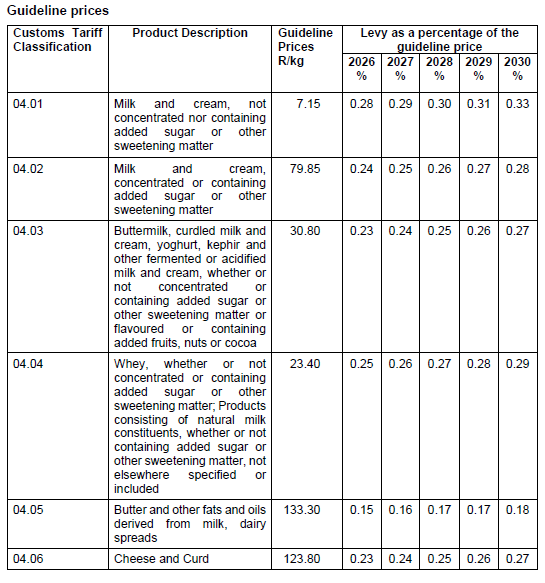
The guideline prices for milk and other dairy products shall be as follows: